- What is a nephrectomy?
- Why is a nephrectomy done?
- Types of nephrectomy
- Pre-operative workup
- The nephrectomy procedure
- Complications of nephrectomy
- Post-operative care
What is a nephrectomy?
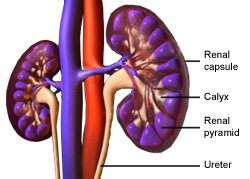 Nephrectomy refers to the surgical removal of a kidney.
Why is a nephrectomy done?
Nephrectomy is indicated for both benign and malignant conditions.
Benign conditions include:
- Renal stones;
- Chronic pyelonephritis;
- Neglected ureteropelvic junction obstruction;
- Renal tuberculosis;
- Polycystic kidney disease;
- Dysplastic kidney; and
- Hypertension.
Malignant conditions include:
Types of nephrectomy
A nephrectomy may be:
- Radical – involving total removal of the kidney, the adrenal gland, nearby lymph nodes and some surrounding tissue; usually performed in cases of neoplastic disease such as renal cell carcinoma (kidney cancer).
- Simple – removal of the affected kidney; usually performed for non-neoplastic disease.
- Partial – also known as nephron sparing surgery removes a portion of the affected kidney and is usually performed in individuals where the kidney tumour is 4 cm or smaller in size. This type of surgery will also be considered for individuals with a single kidney or tumours in both kidneys.
Nephrectomy can be performed laparoscopically (by keyhole surgery) or by open surgery. The laparoscopic technique is becoming increasingly used as it is less invasive requiring only several small incisions into the skin (compared to one large incision for open surgery) or more recently through one small incision in the belly button.
Pre-operative workup
 Prior to the procedure being performed, your surgeon will take a thorough history and examination. There may also be a preoperative consultation with the appropriate specialist if the individual has other significant medical conditions which may complicate the procedure or the recovery.
Several blood tests will be ordered to determine:
- Blood type in the event that a transfusion is required;
- Kidney function; and
- Liver function.
If the reason for the nephrectomy is renal cell carcinoma, additional blood tests may be ordered to determine the probability of metastasis to the skeleton. If this is suspected a bone scan may be performed.
In individuals with significant anaemia, or in those where significant blood loss is anticipated, two canulae or a central venous catheter should be inserted to allow for rapid infusion of fluids or blood products if required.
The nephrectomy procedure
Several prophylactic measures are taken to prevent complications including the use of pneumatic compression stockings and heparin to prevent deep vein thrombosis and the use of intravenous antibiotics to prevent infection.
The individual is positioned on the operating table and secured. The surgical technique varies depending on:
- which kidney is to be removed;
- whether it is a radical, simple or partial nephrectomy;
- the surgeon; and
- whether the surgery is to be performed laparoscopically or by open methods.
Both laparoscopic and open surgery are carried out under a general anaesthetic in an operating theatre. There are several differences between the two. Open surgery involves a single larger incision whereas laparoscopic surgery involves several small incisions. In laparoscopic surgery the instruments used to carry out the procedure are attached to long probes which are passed through the small incisions.
Complications of nephrectomy
 Complications may be related to the use of anaesthetic, surgery in general or to the specific surgery performed. Like most surgical operations, the most common complications are bleeding (which may require a transfusion) and infection. The complications, and their frequency, related to your specific operation will be fully discussed with you prior to the procedure.
Post-operative care
Postoperatively, analgesia will be given in the form of non-steroidal antiinflammatory drugs and oral narcotics. Early fluid intake and diet as tolerated is encouraged along with early ambulation (walking). For laparoscopic procedures, ambulation is encouraged beginning postoperative day 1 and individuals with uncomplicated operations are usually discharged home on postoperative day 2. When discharged from the hospital, individuals are given oral pain relief and encouraged to use stool softeners as postoperative constipation is not uncommon.
The time taken to return to normal activities is approximately three weeks for laparoscopic nephrectomies and approximately six weeks for open surgery. The Australian Urology Associates recommend avoiding strenuous activity for at least three weeks following laparoscopic nephrectomy and this may be increased for open nephrectomy. Driving is also not advisable until you are capable of braking hard and able to have full control of the vehicle (typically around three weeks for the laparoscopic procedure).
Follow up with health professionals after the surgery depends on the reason for nephrectomy and will be discussed with you before discharge. The doctor will give you a list of worrying signs that may require you to seek medical attention before your scheduled follow up. In particular, wounds should be kept clean and dry and if you notice any signs of wound infection including redness, warmth, pus or you develop fevers you should seek medical attention.
More information
 |
For more information on kidney anatomy, cancer, animations and treatment, see Kidney Cancer. |
References
- Graham SD, Keane TE, Glenn JF (eds). Glenns’ Urologic Surgery 6th Ed. 2004. Lippincott Williams & Wilkins.
- Clayman RV, Kavoussi LR, Soper NJ, et al. Laparoscopic nephrectomy: initial case report. J Urol 1991; 146:278-82.
- Rafique M. Nephrectomy: indications, complications and mortality in 154 consecutive patients. J Pak Med Assoc 2007; 57: 308-11.
- National Institute for Clinical Excellence. Interventional procedures overview of laparoscopic nephrectomy (including nephroureterectomy). Available from: < http://www.nice.org.uk/nicemedia/pdf/ip/277%20lap%20nephrectomy%20overview%20FINAL%20for%20web.pdf> [17 January 2010].
- Portis AJ, Yan Y, Landman J, et al. Long-term follow up after laparoscopic radical nephrectomy. J Urol 2002; 167: 1257-62.
- Chan DY, Cadeddu JA, Jarrett TW, Thomas W, Marshall FF, Kavoussi LR. Laparoscopic radical nephrectomy: cancer control for renal cell carcinoma. J Urol 2001; 166: 2095-2099; discussion 2099-100.
- Dunn MD, Portis AJ, Shalhav AL, Elbahnasy AM, Heidorn C, McDougall EM, Clayman RV. Laparoscopic versus open radical nephrectomy: a 9-year experience. J Urol 2000; 164: 1153-9.
- Lotan Y, Gettman MT, Roehrborn CG, Pearle MS, Cadeddu JA. Cost comparison for laparoscopic nephrectomy and open nephrectomy: analysis of individual parameters. Urology 2002; 59: 821-5.
- Simon SD, Castle EP, Ferrigni RG, Lamm DL, Swanson SK, Novicki DE, Andrews PE. Complications of laparoscopic nephrectomy: the mayo clinic experience. J Urol 2004; 171: 1147-50.
- Australian Urology Associates. Laparoscopic nephrectomy surgery. Available from: < http://www.aua.com.au/Content_Common/pg-laparoscopic-kidney-removal-nephrectomy.seo> [17 January 2010].
All content and media on the HealthEngine Blog is created and published online for informational purposes only. It is not intended to be a substitute for professional medical advice and should not be relied on as health or personal advice. Always seek the guidance of your doctor or other qualified health professional with any questions you may have regarding your health or a medical condition. Never disregard the advice of a medical professional, or delay in seeking it because of something you have read on this Website. If you think you may have a medical emergency, call your doctor, go to the nearest hospital emergency department, or call the emergency services immediately.
Related Articles



Need a health appointment?
Find and book a doctor, dentist, physio and more on Healthengine
Find a practitioner