


 Login
LoginImportance of Regular Dental Check-Ups


Introduction to dental check-ups
Even though many of us might think that our teeth are in good shape, regular visits to the family dentist are very important. Regular care and prevention of diseases in the mouth are the best possible care you can give your teeth. Tackling problems early on will save a lot of bother in the long run – it might save your tooth from an extraction or root canal therapy. It is important to visit your dentist at least once, but ideally twice, a year to get your teeth checked and cleaned.
Some non-dental conditions have symptoms that appear in the mouth. A dental examination can reveal signs of vitamin and iron deficiencies, osteoporosis, or more serious conditions such as diabetes, cancer, HIV and glandular fever, to name but a few.
Dental check-ups in children
By taking children to the family dentist, problems such as crowded, missing, and crooked teeth as well as problems associated with diet, dental hygiene, and the jaws can be addressed. The earlier a dentist discovers these problems, the less difficult and expensive the treatment becomes. The dentist may also recommend a mouthguard for those children who play sport where a tooth can be damaged or knocked out.
Fissure sealants, which are small plastic fillings, can be placed in deep fissures (grooves) in the tooth. These are placed to prevent tooth decay in these deep fissures, which are often not easily cleaned by a toothbrush or mouthwash. Fissure sealants can be recommended at a dental check-up.
 | For more information on dental health in children, including teething, hygiene and nutrition for good teeth, see Dental Health in Children. |
The exam
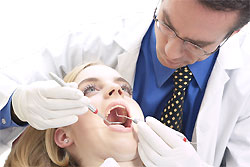 Firstly the soft tissues are checked for ulcerations or other lesions. The dentist will also check the jaws and associated muscles.
Then the teeth are checked carefully for cavities and broken fillings along with other possible problems with the tooth. Each tooth is checked sequentially to make sure nothing is missed. The dentist will then check the gums and your general oral hygiene to ensure there are no problems there.
The dentist may then take radiographs if necessary. Usually two small radiographs of your back teeth are taken every two years or when you attend a new dentist. There may be a need to take a panoramic radiograph as well, which gives a full view of both top and bottom jaws. These show any hidden decay between the teeth, trauma to the jaws, problems with wisdom teeth, and gum disease.
At the exam, the dentist will usually clean your teeth as well. You cannot remove hardened plaque (known as calculus or tartar), thus the dentist needs to remove this regularly (every 6-12 months).
There are many more things the dentist can do to improve your dental hygiene and your smile. Help with correct brushing, flossing, diet, fluoride protection, overcoming tooth sensitivity, dry mouth, bad breath, replacing old fillings with decay, and replacing missing teeth with dental bridges, dentures and/or dental implants are some more of the topics that your dentist will be happy to discuss with you.
A beautiful smile
 Once the exam is complete, the dentist can give you advice on what is required next. Treatment can be discussed to repair stained, chipped, crooked, and missing teeth, as well as those teeth with tooth decay and gum disease.
You can discuss special treatments to whiten teeth and consider coatings made of plastic or porcelain to improve the shape and colour of your teeth (veneers). It is important to remember that these are the last step in treatment; the most important part of a beautiful smile is a healthy smile, so tooth decay and gum disease must all be controlled before even thinking about these options.
References
- Australian Dental Association. Patient education pamhplets: Patient recall mailer – Time for a check up. Brochure 2009
- Therapeutic guidelines: Oral and Dental. 1st ed. North Melbourne: Therapeutic Guidelines Limited; 2007.
- Newman M, Takei H, Klokkevold P. Carranza’s Clinical Periodontology. 10th ed. Carranza F, editor. St Louis: Saunders, Elsevier; 2006.
- Field A, Longman L. Tyldesley’s Oral Medicine. 5th ed. Oxford: Oxford University Press; 2003.
- Oral health policies. American Academy of Pediatric Dentistry. Pediatr Dent 1999;21:18-37.
- Australian Dental Association. Patient education pamhplets: Dental care for babies and young children. Brochure 2009
- Cameron A, Widmar, R. Handbook of Paediatric Dentistry. London: Mosby 1997.
- Australian Dental Association. Patient education pamhplets: Fissure sealants. Brochure 2009
- Australian Dental Association. Patient education pamhplets: Dental x-ray examinations. Brochure 2009
Dates


Created by: