- Introduction to the body mass index (BMI)
- What does your BMI mean?
- Why are BMIs useful?
- Risks associated with extreme BMIs
- What are the limitations of the BMI?
- Other measures of obesity
Introduction to the body mass index (BMI)
The body mass index (BMI) is a physical measurement used to assess an individual’s total amount of body fat. The BMI was invented by Belgian polymath Adolphe Quetelet in the 1800s, and consequently is sometimes known as the Quetelet index. The BMI is calculated by dividing your weight in kilograms (kg) by your height in metres squared (m2). It is expressed as kg/m2. Calculate your BMI using the calculator below, then compare your result to the BMIs in Table 1.
This information will be collected for educational purposes, however it will remain anonymous.
What does your BMI mean?
The BMI scores give an indirect measure of body fat. Depending on the BMI value calculated you may be underweight, healthy weight, overweight or obese. The cut off values are as follows:
| BMI | Classification |
|---|---|
|
< 18.5 |
Underweight |
|
18.5–24.9 |
Healthy weight |
|
25.0–29.9 |
Overweight |
|
30.0–34.9 |
Obese Class 1 |
|
35.0–39.9 |
Obese Class 2 |
|
> 40.0 |
Obese Class 3 |
Why are BMIs useful?
The BMI is a simple, inexpensive screening tool used to identify possible weight problems for both adults and children. A BMI measurement is useful to assess who needs further testing to identify health risks such as heart disease. Individuals at risk will need further assessment. Assessments may include skin fold thickness test, diet, physical activity level, family history and other appropriate health screenings.
Book your health appointments online
Find and instantly book your next health appointment with Healthengine
Risks associated with extreme BMIs
 Being either overweight (with a BMI of 25 or above) or underweight (with a BMI lower than 18.5) can affect your health.
Overweight
Individuals who are overweight or obese have a greater risk of disease compared to those in the healthy weight range. The risk of disease increases with increasing BMI. Those classified overweight (BMI 25-29.9) may also be considered pre-obese and are at an increased risk of disease. In Category 1 obesity (BMI 30-34.9) there is a moderate risk of disease, which increases to severe and very severe risk at obesity stages 2 (BMI 35-39.9) and 3 (BMI ≥40) respectively.
It is important to note that BMI does not determine risk alone. Other factors such as what one eats, how much they exercise and whether or not there is a history of disease in their family also influences an individual’s risk of disease. However as a group, overweight and obese individuals have an increased risk of many diseases.
They have a greatly increased risk of:
- Type 2 Diabetes;
- Gall bladder disease;
- Hypertension;
- Dyslipidaemia;
- Insulin Resistance;
- Atherosclerosis;
- Sleep apnoea;
- Breathlessness
- Asthma;
- Social isolation and depression;
- Daytime sleepiness and fatigue.
They have a moderately increased risk of:
- Cardiovascular diseases (i.e. stroke, heart attack);
- Gout /hyperuricaemia;
- Osteoarthritis;
- Respiratory disease;
- Hernia;
- Psychological problems.
They have a slightly increased risk of:
- Some forms of cancer (breast, colon and endometrial cancers);
- Reproductive abnormalities;
- Impaired fertility;
- Polycystic ovarian syndrome;
- Skin complications;
- Cataract;
- Varicose veins;
- Musculskeletal problems;
- Bad back;
- Stress incontinence;
- Oedema/cellulitis.
Underweight
Individuals who are underweight may be malnourished. In addition they have an increased risk of developing health problems including:
- Compromised immune function with increased susceptibility to infections;
- Anaemia;
- Osteoporosis;
- Menstrual irregularities;
- Impaired fertility.
What are the limitations of the BMI?
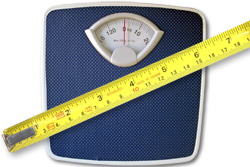 Limitations associated with the BMI are:
- BMI varies by age, sex and race. Hence one’s BMI can only be compared to those of the same sex, age and race.
- BMI does not differentiate between muscle and fat and will therefore underestimate in some and overestimate for others (e.g. An athlete may have a high BMI because of greater amount of muscle rather than fat).
- Disabled or elderly people have less muscle mass and therefore will have a lower BMI. This does not necessarily mean that their weight is normal or underweight.
- Pregnant women will also have a higher BMI because of increased weight associated with pregnancy, but not necessarily due to increased fat. BMI will overestimate body fat in this case. Pre-pregnancy BMI and weight gain during pregnancy should be used to assess a woman’s weight and the need for exercise and nutritional interventions.
- BMI does not differentiate between body fat distribution. Fat around the waist (“apple” body shape) is more dangerous than that around the hips (“pear” body shape), but this will not be picked up by the BMI.
Consult your healthcare giver for other physical measures that may need to be used along with BMI for assessing health risks associated with obesity.
Other measures of obesity
Table 2: Other measures of obesity
| Measure | Description |
|---|---|
| Waist circumference | Waist circumference (WC) is a good indicator of abdominal fat and can be used to indicate health risks. It is measured by putting an unstretched tape measure around the narrowest level of your waist over light or no clothing.
Risk also varies based on ethnicity and health risk are higher with a lower WC in certain ethnic groups including Aboriginal, Pacific Islander, South Asian, Chinese and Japanese populations. |
| Hip circumference | Hip circumference (HC) is measured by putting a tape around the widest part of your hip area over minimal clothing. HC is not useful on its own; usually it is used as a ratio with WC as above. |
| Waist–hip ratio | Waist to hip ratio (WHR) is the ratio of your waist circumference to your hip circumference. For females the normal WHR is about 0.80, while for men it is 0.95. |
| Waist–height ratio | Waist to height ratio is the ratio of your waist circumference to your height. |
More information
 |
For more information on nutrition, including information on types and composition of food, nutrition and people, conditions related to nutrition, and diets and recipes, as well as some useful videos and tools, see Nutrition. |
 |
For more information on obesity, health and social issues, and methods of weight loss, as well as some useful tools, see Weight Loss. |
References
- National Health and Medical Research Council. Clinical Management Guidelines for the management of overweight and obesity in adults, adolescents and children in Australia. 2013. [cited 14 April 2014]. Available from: [URL Link]
- Centre for Disease Control and Prevention. About BMI for Adults. 2011. [cited 14 April 2014] Available from: [URL Link]
- Keys A, Findanza F, KarvonenMJ, et al. Indices of relative weight and obesity. J Chron Dis. 1972; 25: 329-43. [Abstract]
- Goh LGH, Dhaliwal SS, Welborn TA, et al. Anthropometric measurements of general and central obesity and the prediction of cardiovascular disease risk in women: a cross-sectional study. BMJ Open. 2014: 4; e004138 doi:10.1136/bmjopen-2013-004138 [Full Text]
- Snijder MB, van Dam RM, Visser M, Seidell JC. What aspects of body fat are particularly hazardous and how do we measure them? Int. J. Epidemiol. 2006;35(1):83-92. [Full Text]
- Gill T, Chittleborough C, Taylor A, Ruffin R, Wilson D. Body mass index, waist hip ratio, and waist circumference: which measure to classify obesity. Int J Public Health. 2003;48(3):191-200. [Full Text]
- Pouliot M, Despers J, Lemieux S, Moorjan S. Waist circumference and abdominal sagital diameter: best simple anthropometric indexes of abdominal visceral adipose tissue accumulation and related cardiovascular risk in men and women. Am J Cardiol. 1994; 73(7): 460-8. [Abstract]
- Schneider J, Glaesmer H, etal. Accuracy of anthropometric indicators of obesity to predict cardiovascular risk. J Clin Endocrinol. 2007; 92(2): 589-594. [Full text]
- Kunesova M, Hainer V, Hergetova H, Zak A. Simple anthropometric measurements – relation to body fat mass, visceral adipose tissue and risk factors of atherogenesis. SB Lek. 1995; 96(3): 257-67. [Abstract]
- Seidell JC, Perusse L, Despres J-P, Bouchard C. Waist and hip circumferences have independent and opposite effects on cardiovascular disease risk factors: the Quebec Family Study. Am J Clin Nutr 2001; 74(3): 315-321. [Full Text]
- Mukuddem-Petersen J, Snijder MB, et al. Sagittal abdominal diameter: no advantage compared with other anthropometric measures as a correlate of components of the metabolic syndrome in elderly from the Hoorn Study. Am J Clin Nutr. 2006; 84(5): 995-1002. [Abstract]
- Lean M. Waist Circumference as a measure for indicating need for weight management. BMJ 1995;311:158-161. [Full Text]
- Esmailzadeh A, Mirmiran P, Azizi F. Waist-hip ratio is a better screening measure for cardiovascular risk factors than other anthropometric indicators in Tehranian adult men. Int J Obesity 2004; 28: 1325-1332. [Abstract]
- Australian Government Department of Health. About Overweight and Obesity. 2009. [cited 14 April 2014] Available from:[ URL Link]
- NHS Choices. Underweight Adults. 2012. [cited 14 April 2014]. Available from: [URL Link]
All content and media on the HealthEngine Blog is created and published online for informational purposes only. It is not intended to be a substitute for professional medical advice and should not be relied on as health or personal advice. Always seek the guidance of your doctor or other qualified health professional with any questions you may have regarding your health or a medical condition. Never disregard the advice of a medical professional, or delay in seeking it because of something you have read on this Website. If you think you may have a medical emergency, call your doctor, go to the nearest hospital emergency department, or call the emergency services immediately.
Related Articles


Need a health appointment?
Find and book a doctor, dentist, physio and more on Healthengine
Find a practitioner