- What is Atopic Dermatitis (Eczema)
- Statistics on Atopic Dermatitis (Eczema)
- Risk Factors for Atopic Dermatitis (Eczema)
- Progression of Atopic Dermatitis (Eczema)
- Symptoms of Atopic Dermatitis (Eczema)
- Clinical Examination of Atopic Dermatitis (Eczema)
- How is Atopic Dermatitis (Eczema) Diagnosed?
- Prognosis of Atopic Dermatitis (Eczema)
- How is Atopic Dermatitis (Eczema) Treated?
- Atopic Dermatitis (Eczema) References
What is Atopic Dermatitis (Eczema)
 |
Dr Joe Kosterich talks about eczema, including what it is, who gets it and when, where it occurs and what it looks like, theories about what causes it, how serious it is, and what to do about it. View the video. |
Atopic dermatitis, or eczema, is a chronic skin disease in which the skin becomes red, dry, itchy or scaly and may weep, bleed and crust over. ‘Atopic’ is a term used to describe allergic conditions for which there is a family history , ‘dermatitis’ means inflammation of the skin.Eczema is part of the ‘atopic triad’ of allergic conditions (also including asthma and hay fever) in which many sufferers experience all three conditions. It is the incessant itch of eczema that separates it from other skin diseases such as psoriasis.The site of the disease depends on the age of the patient.
- In young children, the dermatitis typically occurs on the face, scalp, limbs, or body trunk. The nappy areas are usually spared.
- In older children and adolescents, the dermatitis is often accompanied by thickening and darkening of the skin, as well as scarring from repeated scratching. The sites involved are usually the extensor areas, ie the knee and elbow areas.
- In adults, the dermatitis most commonly affects the back of the neck, the elbow creases, and the backs of the knees (called the flexural areas). Other affected areas may include the face, wrists, and forearms.
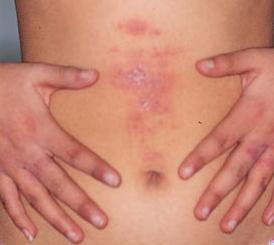 Statistics on Atopic Dermatitis (Eczema)Eczema is becoming increasingly common. About 8 to 25% of people worldwide have eczema, compared to 4% in the 1940s. It often occurs in people who have other allergic disorders, such as asthma and hay fever.Eczema may occur at any age, however most often eczema begins in infancy and childhood. Eczema typically manifests in infants aged 1-6 months. Eczema equally affects males and females; however females generally have a worse prognosis.Risk Factors for Atopic Dermatitis (Eczema)Eczema is caused by a complex interaction between genes and environmental triggers. Researchers have found that around two-thirds of eczema cases and a quarter of asthma cases involve mutations to a gene that helps form the skin’s outer protective layer. This outer layer is made up of dead cells that are collapsed together into a continuous protein sheath that keeps water in and invaders such as bacteria out. Filaggrin is one of the proteins that is very important in maintaining this protective barrier. Several studies have now demonstrated an association between mutations in the filaggrin gene and ezcema.Environmental triggers that start off eczema have also been identified. Anything that could dry the skin may worsen atopic dermatitis. Potential triggers include:
- Skin infections;
- Emotional stress;
- Food or preservatives;
- Pollens and dust mites;
- Exposure to tobacco smoke;
- Irritating clothes and chemicals (loose or poorly fitting clothing that constantly rubs the skin or contact with solvents, detergents, deodorants, cosmetics, and soaps);
- Excessively hot or cold climate or environment (hot showers or baths, overdressing, use of electric blankets or heating pads, and exposure to high humidity);
- Excessive bathing, hand washing, lip licking, sweating, or swimming.
Progression of Atopic Dermatitis (Eczema)The predominant symptom is intense itch. In children, sometimes itching can be so intense that the skin breaks after prolonged scratching. In this case sometimes infection leading to pus formation may occur.Symptoms of Atopic Dermatitis (Eczema)Most people with atopic dermatitis first develop symptoms before five years of age. Intense itching of the skin is a prominent symptom along with redness, small bumps, and flaking. These symptoms vary with age and from individual to individual. The itchiness may be more noticeable at night time.It is important for the health professionals to know if there is any family history of atopic diseases (as discussed above) like asthma and/or hay fever. The clinical history will also include important details like the possible triggers of the itching, the complications of such, and other associated features.Clinical Examination of Atopic Dermatitis (Eczema)A skin examination will be carried out. Usually the diagnosis is fairly obvious for the health professional – typical appearances include dry, scaly and red skin due to inflammation. The person might be scratching the skin on examination.Additional skin findings may include:
- Lichenification: Thick, leathery skin (usually resulting from chronic constant scratching);
- Ichthyosis: Dry scaly skin, much like ‘fish skin”
- Keratosis pilaris: Plugged hair follicles resulting in the development of small bumps usually on the face, upper arms, and thighs;
- Cheilitis: Inflammation around the lips;
- Hyperlinear palms: Increased skin creasing on the palms;
- Dennie-Morgan line: An extra fold of skin under the eye;
- Periorbital darkening: Darkening of the skin around the eyes;
- Pityriasis alba: Rounded white patches on the skin (usually on the face) with indistinct border.
How is Atopic Dermatitis (Eczema) Diagnosed?There is no specific test that diagnoses the presence of eczema. Diagnosis is usually based upon a person’s history and the signs noted during a physical examination.Prognosis of Atopic Dermatitis (Eczema)Most eczema patients improve; however, they need to understand that there is no cure for eczema. By following prevention strategies, the chances of exacerbations can be minimized. Eczema tends to fade with age. About 90% of eczema patients have spontaneous resolution by puberty.How is Atopic Dermatitis (Eczema) Treated?Because atopic dermatitis has no cure, the treatment aim is to to prevent outbreaks and to relieve discomfort by controlling the signs and symptoms if an outbreak occurs. Once eczema is diagnosed, a treatment plan will be made based on:
- Type and severity of the eczema present;
- Age, health, and medical history (including presence of other conditions);
- History of previous eczema treatment.
Since eczema is usually dry and itchy, most treatment plans involve applying lotions, creams, or ointments to keep the skin as moist as possible. The treatment plan also may require lifestyle modifications and using medication as directed.
Methods of treatment include:
- Avoiding factors that worsen atopic dermatitis can effectively control the symptoms – this include avoiding exposure to solvents and detergents, managing emotional stress, avoiding rapid temperature changes, and anything that is found to worsen the condition.
- Maintain skin hydration – Emollients are used to return moisture to the skin and often help relieve symptoms. They are most effective when applied after bathing.
- Lukewarm baths can hydrate and cool the skin, temporarily relieving the itching of atopic dermatitis. However, hot or long (greater than 10 to 15 minutes) baths and showers should be avoided since they can cause excessive drying.
- Topical steroid creams and ointments are often effective for controlling mild to moderate atopic dermatitis. Strong topical steroids can be used to control severe flares of atopic dermatitis; however long term use should be avoided due to the risk of serious side effects.
- Other topical treatments for atopic dermatitis such as tacrolimus. They are particularly useful in sensitive areas such as the face and groin, and in children.
- Taking steroids by mouth are occasionally used to treat a flare of chronic atopic dermatitis.
- Oral antihistamines can be used to relieve the symptoms of itching and irritation of the eye that often occurs in conjunction with atopic dermatitis.
- Ultraviolet light therapy (phototherapy) can effectively control atopic dermatitis. However this is reserved for patients not responding to other treatment methods as described above.
- Immunosuppressive drugs can be used to control severe atopic dermatisis. However, these drugs do have serious side effects.
Atopic Dermatitis (Eczema) References
- Krafchik, BR. Atopic dermatitis [online]. Omaha, NE: eMedicine; 2005 [cited 6 October 2005]. Available from: URL link
- Williams HC. Is the prevalence of atopic dermatitis increasing? Clin Exp Dermatol. 1992;17(6):385-91. [Abstract]
- Eczema backgrounder [online]. Cleveland, QLD: Eczema Association of Australasia Inc; 2008 [cited 14 December 2008]. Available from: URL link
- Eczema backgrounder [online]. Cleveland, QLD: Eczema Association of Australasia Inc; 2008 [cited 14 December 2008]. Available from: URL link
- Mar A, Marks R. The descriptive epidemiology of atopic dermatitis in the community. Australas J Dermatol. 1999;40(2):73-8. [Abstract]
- Kay J, Gawkrodger DJ, Mortimer MJ, Jaron AG. The prevalence of childhood atopic eczema in a general population. J Am Acad Dermatol. 1994;30(1):35-9. [Abstract]
- Palmer CN, Irvine AD, Terron-Kwiatkowski A, et al. Common loss-of-function variants of the epidermal barrier protein filaggrin are a major predisposing factor for atopic dermatitis. Nat Genet. 2006;38(4):441-6. [Abstract]
- Barker JN, Palmer CN, Zhao Y, et al. Null mutations in the filaggrin gene (FLG) determine major susceptibility to early-onset atopic dermatitis that persists into adulthood. J Invest Dermatol. 2007;127(3):564-7. [Abstract | Full text]
- Weller R, McLean WHI. Filaggrin and eczema. J R Coll Physicians Edinb. 2008;38(1):45-7. [Full text]
|
Dr Joe Kosterich talks about eczema, including what it is, who gets it and when, where it occurs and what it looks like, theories about what causes it, how serious it is, and what to do about it. View the video. |
All content and media on the HealthEngine Blog is created and published online for informational purposes only. It is not intended to be a substitute for professional medical advice and should not be relied on as health or personal advice. Always seek the guidance of your doctor or other qualified health professional with any questions you may have regarding your health or a medical condition. Never disregard the advice of a medical professional, or delay in seeking it because of something you have read on this Website. If you think you may have a medical emergency, call your doctor, go to the nearest hospital emergency department, or call the emergency services immediately.
Related Articles
Hair loss is a common issue that affects…

Alzheimer’s disease is a progressive neurological disorder that…
Obstructive sleep apnoea (OSA) is a prevalent and…
Need a health appointment?
Find and book a doctor, dentist, physio and more on Healthengine
Find a practitioner