- What is Breast Cancer (Carcinoma of the Breast)
- Statistics on Breast Cancer (Carcinoma of the Breast)
- Risk Factors for Breast Cancer (Carcinoma of the Breast)
- Progression of Breast Cancer (Carcinoma of the Breast)
- How is Breast Cancer (Carcinoma of the Breast) Diagnosed?
- Prognosis of Breast Cancer (Carcinoma of the Breast)
- Breast Cancer (Carcinoma of the Breast) References
What is Breast Cancer (Carcinoma of the Breast)
Adenocarcinoma of the breast is a form of breast cancer originating in the milk ducts and/or lobules (glandular tissue) of the breast. The breast is an organ composed mainly of fatty tissue which also has milk glands contained within it. A series of ducts connect the milk glands to the nipple. The breast is rich in blood vessels and lymphatic channels.
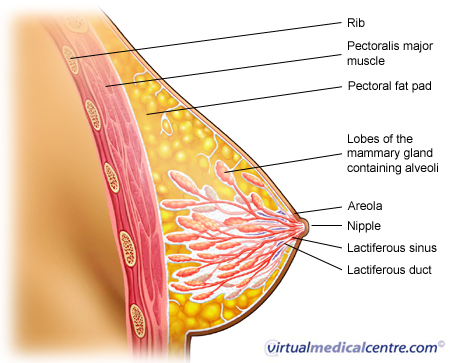
Breast diseases such as breast cancer predominantly affect women. This is because male breasts are more rudimentary than female breasts, making them more resistant to cancer. Breast cancer is sometimes classified into several ‘types’. The major types are:
- Ductal carcinoma (70-80%): cancer cells that resemble the ducts of the breast
- Lobular carcinoma (5-10%): cancer cells that resemble the lobules or glands of the breast
- Medullary carcinoma (1 to 5%)
- Mucinous carcinoma (1 to 6%)
- Tubular carcinoma (2%)
Some features are common to all types of breast cancers. The difference between the different types is mainly in terms of breast cancer prognosis.
Statistics on Breast Cancer (Carcinoma of the Breast)
Breast cancer is the third most common type of cancer in Australia and the most common type of cancer diagnosed in women (excluding basal and squamous cell skin cancers).It accounts for 28% of cancer diagnoses in women. Breast cancer can be divided into in situ breast cancer which is not dangerous but increases the risk of cancer developing in the future (including pre-invasive ductal carcinoma and pre-invasive lobular carcinoma) early breast cancer (invasive cancer which is contained in the cells of the breast) and invasive breast cancer. Statistics produced by the Australian government refer only to invasive breast cancer.
Of the 14,568 primary, invasive breast cancer diagnoses in Australia in 2011, only 103 were in males. The number of incident breast cancer diagnoses made in women each year is approximately double the number of diagnoses of bowel cancer, the second most common cancer in women. Invasive breast cancer is the second leading cause of cancer death in Australian women.
Risk Factors for Breast Cancer (Carcinoma of the Breast)
The main risk factors for breast cancer are:
- Increasing age;
- A family history of breast cancer;
- Hormonal factors: women who begin menstruation early, have a late menopause, or have late or few pregnancies;
- Obesity; and
- Excess alcohol use (daily consumption of >2 standard drinks).
There is also some evidence that long-term hormone therapy (for example the use of the oral contraceptive pill or hormone replacement therapy (HRT)) may increase the risk of breast cancer.
Progression of Breast Cancer (Carcinoma of the Breast)
In some cases, invasive breast carcinoma is preceded by an earlier, ‘pre-cancerous’ condition known as ductal carcinoma in situ (DCIS) or lobular carcinoma in situ (LCIS). In these ‘in situ’ carcinomas, cells of the ducts or lobules of the breast have developed the ability to multiply out of control – one of the characteristics of cancer. However, the cells of in situ carcinoma have not developed the ability to spread beyond the lobules of the breast, as they do in invasive cancer, and instead remain ‘in situ’, or in place.If carcinoma in situ is detected early, for example through mammographic screening, then treatment of carcinoma in situ may prevent development of invasive breast cancer.
How is Breast Cancer (Carcinoma of the Breast) Diagnosed?
Any new breast symptom, such as a lump, is assessed with the ‘triple test’. This includes examination of the breast, imaging of the breast through mammography or ultrasound, and sampling of the breast tissue with fine needle aspiration (FNA), core biopsy or open biopsy.Following a diagnosis of breast cancer, blood tests including Full Blood Count and Liver Function Tests may be used to assess the possibility that the cancer may have spread to the liver or bone marrow. Other imaging tests, including chest x-rays, bone scan, abdominal CT or liver ultrasound may also be used if symptoms suggest that the cancer has spread.
More information
 |
For more information on breast cancer, types of breast cancer and its investigations and treatments, as well as some useful videos, see Breast Cancer. |
Prognosis of Breast Cancer (Carcinoma of the Breast)
Early breast cancer has a good (greater than 80%) 5 year survival. Important prognostic factors which can help predict survival include involvement of lymph nodes, the size of the tumour, and how aggressive the tumour cells are. If the cancer has metastasised (spread) to lung, liver or bone at diagnosis, 5-year survival rates are significantly lower.
Breast cancers in Australia are ‘staged’ based on the TNM (Tumour, Node, Metastasis) system. ‘Early’ breast cancer refers to Stage I, and some Stage II only.
References
- Australian Institute of Health and Welfare & National Breast Cancer Centre 2006. Breast cancer in Australia: an overview, 2006. Cancer series no. 34. cat. no. CAN 29. Canberra: AIHW. [cited 28 September 2015]. Available from: [URL Link]
- Braunwald, Fauci, Kasper, Hauser, Longo, Jameson. Harrison’s Principles of Internal Medicine. 16th Edition. 2001. McGraw-Hill. [Book]
- Cotran RS, Kumar V, Collins T. Robbins. Pathological Basis of Disease. Sixth Ed. WB Saunders Company 1999. [Book]
- Australian Institute of Health and Welfare. Breast Cancer in Australia: an Overview 2012. Cancer series No. 71. Cat. No. CAN67. 2012. [cited 28 September 2015]. Available from: [URL Link]
- Australian Institute of Health and Welfare. Cancer in Australia: an Overview 2014. Cancer Series No. 90. Cat No. CAN88. [cited 28 September 2015]. Available from: [URL Link]
- National Breast Cancer Centre. The clinical management of ductal carcinoma in situ, lobular carcinoma in situ and atypical hyperplasia of the breast First Edition. National [cited 28 September 2015] Available from: [URL Link]
- National Health and Medical Research Council. Clinical practice guidelines for the management of early breast cancer. 2001. Second edition. National Breast Cancer Centre [cited 28 September 2015] Available from: [URL Link]
- National Breast Cancer Centre. 2003. ‘A guide for women with early breast cancer.’ National Breast Cancer Centre, Camperdown, NSW. [online] Available from: [URL link]
- Cancer Australia. What is ductal carcinoma in situ. 2015. [cited 28 September 2015]. Available from: [URL Link]
- Cancer Australia. What is lobular carcinoma in situ. 2015. [cited 28 September 2015]. Available from: [URL Link]
All content and media on the HealthEngine Blog is created and published online for informational purposes only. It is not intended to be a substitute for professional medical advice and should not be relied on as health or personal advice. Always seek the guidance of your doctor or other qualified health professional with any questions you may have regarding your health or a medical condition. Never disregard the advice of a medical professional, or delay in seeking it because of something you have read on this Website. If you think you may have a medical emergency, call your doctor, go to the nearest hospital emergency department, or call the emergency services immediately.
Related Articles

Alzheimer’s disease is a progressive neurological disorder that…

Obstructive sleep apnoea (OSA) is a prevalent and…

The world of healthcare is rapidly changing, and…
Need a health appointment?
Find and book a doctor, dentist, physio and more on Healthengine
Find a practitioner