- An Introduction to Teeth
- Purpose of Teeth
- Classification and Location of Teeth
- Primary Teeth Eruption Sequence
- Tooth Structure
An Introduction to Teeth
Children’s teeth play an important role in digestion and reserving spaces for permanent teeth. Children’s teeth are also known as primary teeth. Due to the smaller jaw size of a child, there are only 20 teeth in total. In comparison there are 32 teeth in an adult’s mouth. Children are not born with teeth. Teeth usually begin to erupt from 10 months of age and finish around 29 months of age. The primary teeth consist of incisors (cutting teeth), canines (tearing teeth) and molars (grinding teeth). The tooth consists of a crown and root, and the tooth is composed of different materials that aid in strengthening, preserving and maintaining its function.
Purpose of Teeth
- To breakdown food into smaller pieces to aid in the process of digestion.
- Maintains a space for permanent teeth to come through.
Classification and Location of Teeth
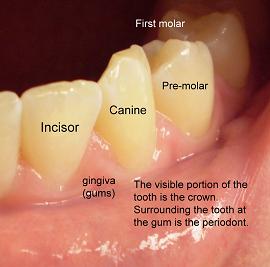
- Children have 20 teeth in their mouth.
- There are 10 teeth on both the top and bottom jaw.
- Each jaw consists of specific teeth, which are incisors (cutting teeth), canines (tearing teeth) and molars (grinding teeth).
- From the midline of one side of each jaw consists of 2 incisors, 1 canine and 2 molars.
Get on top of your dental health
Find and instantly book affordable dentists within Australia
Primary Teeth Eruption Sequence
- Begins around 10 months and ends around 29 months.
- Specific eruption times are:
- Incisors= 10 months (8-13 months).
- Canines= 19 months (16-22months).
- 1st Molars= 16 months (13-19 months).
- 2nd Molars = 29 months (25-33 months).
Tooth Structure
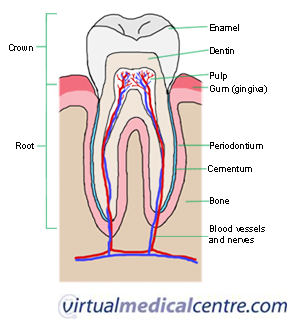 The anatomy of the tooth consists of root (hidden in the gum) and crown (visible part of the tooth).
- The root of the tooth functions as an anchor for the tooth and allows for blood and nerve supply to enter the tooth to maintain its viability.
- The crown is the surface that allows for food breakdown as opposing teeth are brought together when chewing.
- The crown and root consists of hard and soft tissue.
- The hard tissue covering the crown is called enamel, a hard mineral surface, where as the root is covered by cementum, a hardy mineral surface, however, it is softer compared to enamel.
- The next layer under both enamel and cementum is dentin, the main bulk of the tooth. Dentin is considered a hard tissue, however, it is much more porous than either of the other hard tissues to allow nutrients to be transferred through the tooth layers.
- The next layer under dentin is the pulp tissue that is housed in pulp cavity. The pulp cavity has a rich blood supply and nerve supply, which is essential for maintaining tooth health.
- The root of the tooth is embedded in bone, which is covered in tissue called gingiva. The root is held in place by strands of tissue that originated from the surrounding bone and embedded into cementum. These strands of tissue are called periodontal ligaments.
More information
 |
For more information on dental health and hygiene in children aged 0 to 5 years, see Dental Health in Kids. |
References
- Ash M: Wheeler’s Dental anatomy, physiology and occlusion. 7th edition, Philadephia, W.B. Saunders Company,1993.
- Moore K, Dalley A: Clinical oriented anatomy. 4th edition, Philadephia, Lippinocott Williams & Wilkins, 1999.
All content and media on the HealthEngine Blog is created and published online for informational purposes only. It is not intended to be a substitute for professional medical advice and should not be relied on as health or personal advice. Always seek the guidance of your doctor or other qualified health professional with any questions you may have regarding your health or a medical condition. Never disregard the advice of a medical professional, or delay in seeking it because of something you have read on this Website. If you think you may have a medical emergency, call your doctor, go to the nearest hospital emergency department, or call the emergency services immediately.
Related Articles



Need a health appointment?
Find and book a doctor, dentist, physio and more on Healthengine
Find a practitioner