- What is menstruation?
- Phases of the menstrual cycle
- The hypothalamus
- The pituitary gland
- Ovaries
- Endometrium
What is menstruation?
Menstruation describes the female period. The menstruation cycle begins when a woman gets her periods. The menstrual blood which leaves her body are products shed from the uterus (the uterine lining also called the endometrium). During the remainder of the menstrual cycle the uterine lining regrows. It does so in preparation for pregnancy, which occurs if the egg (oocyte) a woman releases about half way through her menstrual cycle is fertilised. When fertilisation occurs, the lining stays in place to nourish the fertilised egg. When fertilisation does not occur the menstrual cycle continues and the uterine lining is shed marking the start of the woman’s next menstrual period. Women begin menstruation at an average age of 13 (called menarche) and on average continue menstruating till age 51 (called menopause).Menstruation involves highly complex hormonal interactions. The key hormones involved in menstruation are oestrogen and progesterone (produced by the ovaries) and luteinising hormone and follicle stimulating produced by the pituitary gland, under the influence of hormones secreted by the hypothalamus. The interactions between these organs are referred to as the hypothalamic-pituitary-ovarian axis (HPO axis).
Information on re-publishing of our images
Phases of the menstrual cycle
The menstruation cycle refers to the cycles in which a woman’s uterus grows and sheds a lining (the endometrium) which could support the development of a fertilised egg. It typically occurs in 28 day cycles, so a woman generally gets her period every 28 days. However, cycle length may be as short as 21 days or as long as 40 days in some women. The inner lining of the uterus (the endometrium) goes through three phases during the typically 28 day menstrual cycle: the menstrual phase (days 1-5), the proliferative phase (days 6-14) and the secretory phase (days 15-28).
The ovarian cycle, refers to the cycle in which a woman’s ovaries prepare an egg to be released during ovulation. It is divided into two phases: the follicular phase (days 1-14) and the luteal phase (days 15-28), during which different levels of hormones are released. These two cycle occur in a synchronised manner; day 1 of the ovarian cycle is always also day 1 of the menstrual cycle.
Day 1 of the menstrual cycle coincides with the start of a woman’s period (menstrual bleeding) in which the uterus sheds the lining (endometrium) built up in the previous menstrual cycle. The lining of the uterus is regrown during each menstrual cycle. Menstrual bleeding typically continues for 3-5 days in what is known as the menstrual phase of the cycle. Between 50-150ml of blood is released during this period.
After the woman’s period, the proliferative phase of the menstrual cycle begins. The uterine lining is regenerated in preparation for receiving a fertilised egg (should fertilisation occur). The regrowth of the lining each month is needed to create an environment suitable for development of a fertilised egg. If the egg released during ovulation is fertilised and the woman becomes pregnant, the uterine lining stays in place and nourishes the fertilised egg.
If the egg is not fertilised then the menstrual cycle continues for another 14-15 days (the secretory phase). This period is usually the same length, regardless of the total length of the woman’s menstrual cycle. Levels of oestrogen, progesterone, luteinising hormone and follicle stimulating hormone all decline. This causes the blood vessels supplying the uterine lining to deprive the endometrium of the nutrients and oxygen it needs to survive. The cells of the endometrium begin to die and shed, resulting in menstrual bleeding and the commencement of a new menstrual cycle.
As the uterus is preparing its lining in the proliferative phase, the woman’s ovaries are preparing an egg for release. Her oestrogen levels rise stimulating the growth of several ovarian follicles. Each of the follicles contains one egg (oocyte) which matures as the follicle grows. Usually only one follicle (known as the dominant follicle) fully matures and releases the egg it contains. The release of the egg is referred to as ovulation. Rarely a woman will develop and release two or more eggs, and this is when multiple pregnancy occurs (e.g. triplets, depending on the number of eggs released).
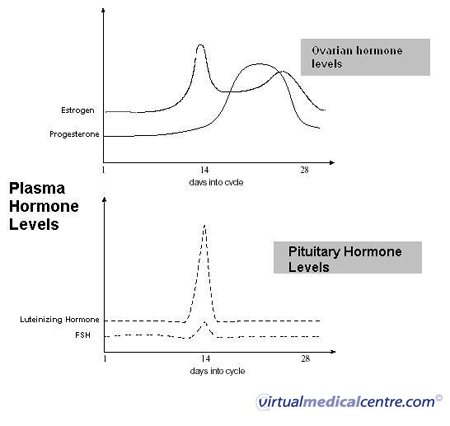
In a typical 28 day cycle, ovulation or the release of a mature egg occurs on Day 14, marking the end of the follicular phase. Ovulation will occur earlier in shorter cycles and later in longer cycles. Ovulation occurs when levels of luteinising hormone (a hormone secreted by the pituitary gland in the brain) in the woman’s body rise rapidly. The surge in luteinising hormone signals the ovaries to release the mature egg/s and marks the beginning of the luteal phase of the ovarian cycle. Once released from the ovaries an egg may be fertilised by male sperm, in which case it will be nourished by the uterine lining and establish a pregnancy. Pregnancy changes the woman’s hormonal balance and interrupts the menstrual and ovarian cycles. If the egg is not fertilised it will exit the woman’s body and the ovarian and menstrual cycles continue.
|
Menstruation occurs in cycles. The ovaries prepare an egg (oocyte) for release and the womb (uterus) prepares a lining to nourish the egg if it is fertilised. When the egg is not fertilised, the lining of the womb is shed and a woman gets her period (menstrual bleeding). Menstruation typically occurs in 28 day cycles so most women get their period every 28 days. However, some women have longer cycles and may only get their period every 40 days, while other have shorter menstrual cycles and may get their periods as often as every 21 days. The menstruation calculator determines when your next period is due based on a 28 day menstrual cycle. All you need to do is enter the date when your last menstrual bleeding began, and the calculator will tell you when to expect your next period. |
|
| 1. Select your menstrual cycle length: days | |
|
2. Select your last Menstrual Date:
|
Next Menstrual Date Due:
|
|
The information presented here is for general purposes only and should not be used to make diagnosis or treatment decisions. For specific information about your health you should see a health professional. Reference
|
|
The hypothalamus
There are five different hormones released from the hypothalamus that have an effect on the menstrual cycle. These hormones include:
- Gonadotrophin releasing hormone (GnRH)
- Thyrotropin releasing hormone (TRH)
- Somatotropin release-inhibitory factor (SRIF) aka Somatostatin
- Corticotrophin releasing factor (CRF)
- Prolactin release-inhibiting factor (PIF)
Each of these have a different effect on the anterior pituitary gland, stimulating it to release or stop releasing a particular hormone.
Gonadotrophin releasing hormone
Release of this hormone is responsible for the stimulation of specific cells called gonadotrophs in the pituitary gland. This stimulation results in the production of two important hormones called luteinising hormone (LH) and follicular stimulating hormone (FSH) from the pituitary. GnRH is of great importance in the menstrual cycle. One of the most important features of GnRH release is the fact that its release occurs in a pulsatile fashion. At the start of puberty there is a marked increase in the frequency and amplitude of GnRH release.
A part of the brain called the surge centre controls the timing of this increased release of GnRH. The surge centre is present in females very early in life, however it is only as puberty approaches that this centre becomes more responsive to hormonal changes. Throughout the menstrual cycle there is pulsatile release of GnRH. Anything that interferes with the pulse frequency of GnRH can stop the menstrual cycle from occurring. Restoration of this pulsatile GnRH by administering hormones can produce a return to ovulation.
The pituitary gland
Anatomy
The pituitary gland is an outpouching of the base of the brain which lies under the hypothalamus. The close proximity of these two parts of the brain is a reflection of their closely linked function. The pituitary gland is divided into two different parts, each of which have different functions. The anterior pituitary is responsible for housing the gonadotrophs, these are the cells that release hormones important in controlling the menstrual cycle.
Physiology
The anterior pituitary gland is composed of six different cell types and produces six different hormones. The cell type that is of importance in menstruation is the gonadotroph. These cells release follicle stimulating hormone (FSH) and luteinising hormone (LH) and are also responsible for production and storage of these hormones.
FSH
The granulosa in the ovaries are the main target for the action of FSH. In response to FSH stimulation the granulosa cells release oestrogen. The combined effect of oestrogen and FSH is to cause growth and increased oestrogen production.
LH
LH stimulates cells in the ovary, called the theca cells, to produce hormones called androgens which are then transported to the granulosa cells in the ovary for conversion into oestrogens.
Gonadotrophin secretory patterns
The normal ovulatory cycle is divided into two phases called the follicular and luteal phases.
- Follicular phase: is initiated from the day bleeding stops and finishes with a mid cycle surge of LH.
- Luteal phase: this is initiated with the mid-cycle surge of LH which coincides with ovulation and ends with the first day of onset of the period.
Ovaries
Anatomy
The female ovaries are paired, flat, elliptical structures which measure approximately 5cm in diameter. The ovaries are in the abdomen and are suspended by various ligaments. The ovary itself consists of two parts, the outer cortex and the inner medulla. The cortex is where development of the eggs occurs, and the medulla carries nerves and blood vessels.
Physiology
Females are born with approximately 2 to 4 million primary follicles. These fetal follicles contain a developing egg called a primary oocyte surrounded by a layer of granulosa cells. These primary oocytes are part way through a cell division. This process of division doesn’t resume until the time of ovulation. With each ovarian cycle, a handful of ovarian follicles are recruited and usually only one of these ovulates, the remaining unrecruited follicles remain in an inactive state. Development of follicles occurs until menopause.
Hormones in the ovarian cycle
Oestrogen
This is low at the beginning of the menstrual cycle and peaks at the middle and then once again towards the end.
Progesterone
There is little production of this in the first half of menstruation but a significant increase in the second half. The progesterone remains high if pregnancy occurs. Progesterone is responsible for an increased body temperature in pregnancy as well.
Endometrium
Anatomy
The endometrium is the inner layer of the uterus and is attached to the muscle layer of the uterus. It is functionally divided into two distinct zones. The outer part is the part that sheds during the menstrual cycle, and the inner part contains stem cells that helps to regenerate the lost cells.
Physiology
The endometrium goes through three stages during the menstrual cycle:
Menstrual phase
This phase begins with the first day of menstruation. Contraction of the muscle layer occurs expelling the blood and endometrial cells through the vagina. Occurs when oestrogen and progesterone are at their lowest levels.
Proliferative phase
There is oestrogen mediated renewal of the endometrial tissue due to the migration of stem cells from the inner layer. There are new blood vessels and glands that form during this phase.
Secretory phase
Increased secretory activity by the endometrial glands is stimulated by progesterone. The endometrial glands in this phase become more developed. The increased secretory activity in this phase of menstruation creates an ideal environment in the uterus for development of an embryo.
More information
 |
For information on different types of contraception, female anatomy and related health issues, see Contraception. |
References
-
Collier J. Longmore M. & Scally P. Oxford Handbook of Clinical Specialties. 6th ed. Oxford. Oxford University Press. 2003
- Hacker & Moore. Essentials of Obstetrics & Gynaecology. 3rd ed. Philadelphia. WB Suanders. 1998
- Johnson L. R. Essential Medical Physiology. 2nd ed. Philadelphia. Lippincott- Raven. 1998.
- McCarthy A. & Hunter B. Master Medicine: Obstetrics & Gynaecology. 2nd ed. Edinburgh. Churchill Livingstone. 2003
- Moore KL & Dalley AF. Clinically Oriented Anatomy 4th ed. Philadelphia. Lippincott Williams & Wilkins. 1999
- Marieb EN, Hoehn KN. Anatomy and Physiology (3rd edition). San Francisco: Pearson Benjamin Cummings; 2008. [Book]
All content and media on the HealthEngine Blog is created and published online for informational purposes only. It is not intended to be a substitute for professional medical advice and should not be relied on as health or personal advice. Always seek the guidance of your doctor or other qualified health professional with any questions you may have regarding your health or a medical condition. Never disregard the advice of a medical professional, or delay in seeking it because of something you have read on this Website. If you think you may have a medical emergency, call your doctor, go to the nearest hospital emergency department, or call the emergency services immediately.
Related Articles


Need a health appointment?
Find and book a doctor, dentist, physio and more on Healthengine
Find a practitioner